What is clinical obesity?
In 2025, an international group of health experts published a new definition of Clinical Obesity (which can be found here) to help health professionals better understand, diagnose and treat obesity. This new definition recognises obesity as a complex health condition, rather than a description of body weight or size.
Clinical obesity is a chronic health condition in which excess adipose tissue (i.e. body fat) affects a person’s health and increases the risk of current or future health complications. It is a complex, chronic condition influenced by many factors, including genetics, biology, environment, family circumstances and access to healthy opportunities.
In our clinic, we aim to talk about growth in a kind, respectful and supportive way. Our focus is on overall health, healthy habits and improving wellbeing, rather than weight or BMI.
Understanding growth charts
Health professionals commonly measure the height and weight of infants, children and adolescents as a part of routine health assessment. The measurements are plotted into growth charts to look at how a young person grows and develops over time.
One of the tools we use is the ‘BMI-for-age' growth chart. BMI (body mass index) is a measure calculated from a child’s height and weight, that provides an indication of their weight relative to their height. For children and adolescents, BMI is interpreted according to a child’s age and sex, using growth charts.
BMI is considered alongside a child’s growth patterns, medical history, health and development to help identify children who may benefit from additional assessment or support. It is a screening tool and does not provide a diagnosis on its own.
On the BMI-for-age growth chart:
- A BMI between the 85th (orange) and 95th (red) percentiles may indicate overweight
- A BMI over the 95th (red) percentile may indicate obesity
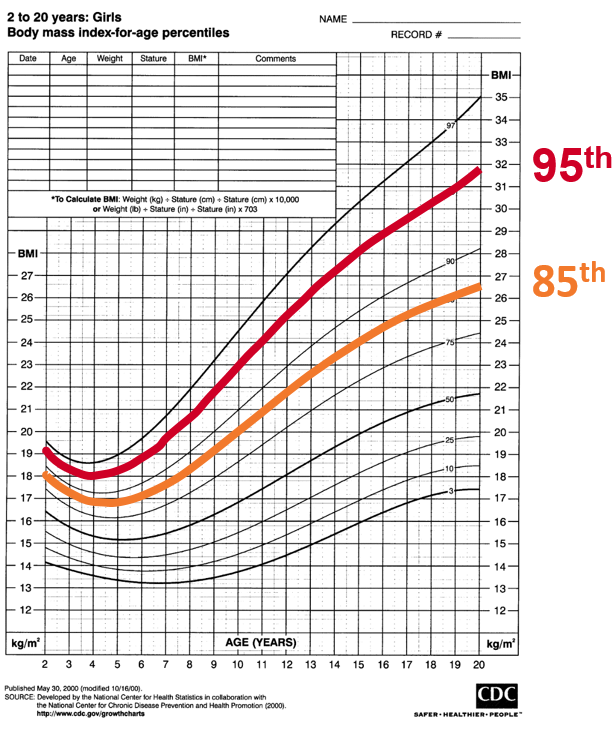
It is important to note that weight or BMI measurements do not take into account a young person’s health or body composition, and many healthy children fall across a range of BMI results. Additional measures of body composition (such as waist circumference or body composition measured by bioelectrical impedance) may be used to help provide a more comprehensive assessment.
Potential health complications of obesity
Children and young people living with obesity may be at increased risk of developing a range of health conditions. These complications can affect physical health, emotional wellbeing and quality of life during childhood, and may continue into adulthood.
Possible complications include:
- High blood pressure (hypertension)
- High cholesterol
- Heart disease (cardiovascular disease)
- Metabolic dysfunction associated steatotic liver disease (MASLD), previously referred to as ‘fatty liver disease’
- Type 2 diabetes
- Breathing difficulties during sleep (obstructive sleep apnoea)
- Hip and joint problems (including slipped upper femoral epiphysis)
- Mental health challenges, including anxiety and depression
- Low self-esteem and reduced confidence
- Reduced quality of life
- Disordered eating patterns
- Challenges with relationships and social participation
- Difficulties with learning, school attendance and/or academic performance